Comparative Cyclic Mechanical Response of Commercial SACH Prosthetic Feet under ISO 10328-Based Fatigue Loading
Abstract
Background: The Solid Ankle Cushion Heel (SACH) foot remains widely prescribed in lower-limb prosthetic rehabilitation, particularly in low- and middle-income countries, because of its simple construction, low maintenance demand, and affordability. However, commercially supplied SACH feet that appear externally similar may respond differently to repetitive loading, and procurement decisions are frequently based on internal inventory labels rather than independent mechanical evidence. Previous studies have mainly characterized prototype designs or single reference feet under static or quasi-static loading, so comparative cyclic evidence for finished commercial SACH feet remains scarce.
Aims: This exploratory study aimed to compare the early observable cyclic mechanical response of two commercial SACH foot groups and to establish a reproducible screening framework for finished commercial components.
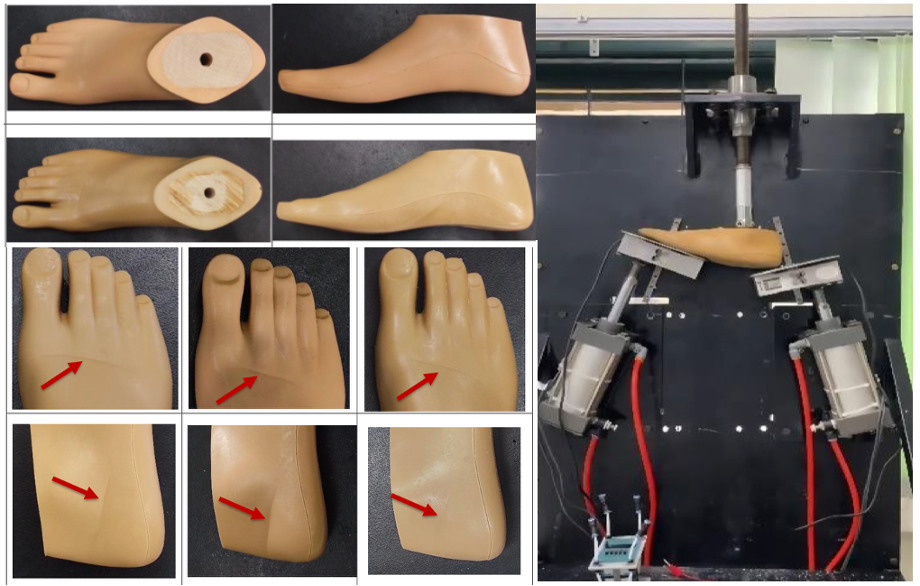
Methods: Six new right-sided SACH feet were tested: three Group B specimens (sizes 23R, 24R, and 25R) and three size-matched Group A specimens. A pneumatic fatigue tester applied alternating heel and forefoot loading following the principles of ISO 10328:2016, Section 17.2.5, with a target range of 50–1,330 N at 1 Hz; the recorded maximum load was 1,460 N for all specimens, representing a 9.8% overshoot. The predefined endpoint was the first visible microdeformation, and specimens without an event were treated as right-censored observations.
Results: All three Group B specimens (3/3, 100%) developed visible dorsal microdeformation at 10,000 cycles, whereas none of the Group A specimens (0/3, 0%) showed a comparable abnormality through 100,000 cycles. One Group B specimen was inadvertently continued to 150,000 cycles after its endpoint because of a protocol communication error. No specimen developed cracking, delamination, permanent deformation, loss of fit, or structural failure.
Conclusion: The scientific contribution of this study is a comparative, endpoint-driven evaluation of finished commercial SACH feet, rather than prototype development, under identical cyclic loading. The findings indicate a consistent difference in early cyclic response under the applied protocol. However, the small sample, visual endpoint assessment, load overshoot, unequal test exposure, and absence of testing to failure preclude conclusions regarding comparative fatigue life or ISO conformity.
Downloads
References
A. S. Nugroho, K. Sasaki, M. Nouman, and R. Ismail, “Design and Mechanical Evaluation of a Polymer Keel SACH Foot Using Finite Element Analysis and Experimental Validation,” J. Electron. Electromed. Eng. Med. Informatics, vol. 8, no. 3, pp. 1148–1162, Jul. 2026, doi: 10.35882/jeeemi.v8i3.1807.
K. Alluhydan, M. I. H. Siddiqui, and H. Elkanani, “Functionality and Comfort Design of Lower-Limb Prosthetics: A Review,” J. Disabil. Res., vol. 2, no. 3, Sep. 2023, doi: 10.57197/JDR-2023-0031.
T. M. Balaramakrishnan, S. Natarajan, and S. Sujatha, “Design of a Biomimetic SACH Foot: An Experimentally Verified Finite Element Approach,” J. Biomimetics, Biomater. Biomed. Eng., vol. 45, pp. 22–30, May 2020, doi: 10.4028/www.scientific.net/JBBBE.45.22.
M. Falbriard et al., “A functional approach towards the design, development, and test of an affordable dynamic prosthetic foot,” PLoS One, vol. 17, no. 5, p. e0266656, May 2022, doi: 10.1371/journal.pone.0266656.
B. J. Hafner, E. G. Halsne, S. J. Morgan, D. C. Morgenroth, and A. T. Humbert, “Effects of prosthetic feet on metabolic energy expenditure in people with transtibial amputation: A systematic review and meta‐analysis,” PM&R, vol. 14, no. 9, pp. 1099–1115, Sep. 2022, doi: 10.1002/pmrj.12693.
World Health Organization and UNICEF, Global report on assistive technology. Geneva, Switzerland: World Health Organization, 2022.
F. M. Kadhim, S. A. Fadhil, A. M. Abdullah, and M. S. Al-Din Tahir, “Designing and manufacturing a flexible heel of a printed prosthetic foot for rehabilitation,” Int. Rev. Appl. Sci. Eng., vol. 16, no. 2, pp. 324–330, Jun. 2025, doi: 10.1556/1848.2024.00930.
S. L. Sashenkov, A. N. Panasenko, A. A. Episheva, F. V. Merkulyev, Y. V. Burnashov, and A. A. Piskaev, “Analysis of Opportunities for the Development of a Brand-New Prosthetic Foot,” Hum. Sport Med., vol. 23, no. 4, pp. 155–162, 2023, doi: 10.14529/hsm230419.
T. M. Balaramakrishnan, S. Natarajan, and S. Sujatha, “Biomechanical design framework for prosthetic feet: Experimentally validated non-linear finite element procedure,” Med. Eng. Phys., vol. 92, no. 1, pp. 64–70, Jun. 2021, doi: 10.1016/j.medengphy.2021.04.006.
E. N. Abbas, K. K. Resan, M. J. Jweeg, E. K. Njim, and R. Madan, “Fabrication and experimental analysis of a novel flexible keel prosthetic foot utilizing functionally graded materials,” J. Med. Eng. Technol., vol. 50, no. 1, pp. 56–64, Jan. 2026, doi: 10.1080/03091902.2025.2570158.
H. A. Abdalwahhab and K. K. Resan, “Development and mechanical analysis of a novel prosthetic foot with a flexible keel for improved functionality,” in The International Middle Eastern Simulation and Modelling Conference, MESM 2023, 2024, pp. 71–75.
P. Chauhan, A. K. Singh, and N. K. Raghuwanshi, “The state of art review on prosthetic feet and its significance to imitate the biomechanics of human ankle-foot,” Mater. Today Proc., vol. 62, pp. 6364–6370, 2022, doi: 10.1016/j.matpr.2022.03.379.
N. Worajinda, J. Phromjan, R. Rugsaj, S. Phakdee, and C. Suvanjumrat, “Design and Analysis of a Composite SACH Foot: Experimental Validation and Finite Element Modeling,” Key Eng. Mater., vol. 1016, pp. 115–120, Jun. 2025, doi: 10.4028/p-6LrQlL.
P. Maroti et al., “Additive manufacturing in limb prosthetics and orthotics: the past, present and future of 3D printing orthopedic assistive devices,” in Medical Additive Manufacturing, Elsevier, 2024, pp. 179–207. doi: 10.1016/B978-0-323-95383-2.00028-7.
M. Omasta, D. Paloušek, T. Návrat, and J. Rosický, “Finite element analysis for the evaluation of the structural behaviour, of a prosthesis for trans-tibial amputees,” Med. Eng. Phys., vol. 34, no. 1, pp. 38–45, Jan. 2012, doi: 10.1016/j.medengphy.2011.06.014.
V. Plesec, J. Humar, P. Dobnik-Dubrovski, and G. Harih, “Numerical Analysis of a Transtibial Prosthesis Socket Using 3D-Printed Bio-Based PLA,” Materials (Basel)., vol. 16, no. 5, p. 1985, Feb. 2023, doi: 10.3390/ma16051985.
A. Vasanthanathan, S. M. Kennedy, K. Amudhan, K. Jairooban, S. Karthikeyan, and B. Vignesh, “Design, optimization, FEA and fabrication of lightweight CFRP prosthetic foot,” Prog. Eng. Sci., vol. 3, no. 1, p. 100200, Mar. 2026, doi: 10.1016/j.pes.2025.100200.
A. R. N. Al Thahabi, L. M. Martulli, A. Sorrentino, M. Lavorgna, E. Gruppioni, and A. Bernasconi, “Stiffness-driven design and optimization of a 3D-printed composite prosthetic foot: A beam finite Element-Based framework,” Compos. Struct., vol. 337, p. 118053, Jun. 2024, doi: 10.1016/j.compstruct.2024.118053.
L. Baldassari, M. Minuto, E. Gruppioni, and M. Frascio, “Design, Testing and Validation of a Cost Effective and Sustainable Bamboo Prosthetic Foot,” Prosthesis, vol. 7, no. 5, p. 124, Oct. 2025, doi: 10.3390/prosthesis7050124.
K. Shah and M. U. Rehman, “Finite Element Analysis of Custom Designed and Additive Manufactured Total Surface Bearing Prosthesis for Trans-Tibial Amputees,” Appl. Sci., vol. 15, no. 3, p. 1284, Jan. 2025, doi: 10.3390/app15031284.
N. N. Subhash et al., “Structural Performance Assessment of FUPRO Grace Foot,” Trends Biomater. Artif. Organs, vol. 36, no. 2, pp. 94–101, 2022.
E. G. Halsne, J. M. Czerniecki, J. B. Shofer, and D. C. Morgenroth, “The effect of prosthetic foot stiffness on foot-ankle biomechanics and relative foot stiffness perception in people with transtibial amputation,” Clin. Biomech., vol. 80, p. 105141, Dec. 2020, doi: 10.1016/j.clinbiomech.2020.105141.
U. Trinler, D. W. W. Heitzmann, S. Hitzeroth, M. Alimusaj, M. Rehg, and A. Hogan, “Biomechanical comparison of a 3D-printed prosthetic foot with conventional feet in people with transtibial amputation: A prospective cohort study,” Prosthetics Orthot. Int., vol. 47, no. 1, pp. 94–100, Feb. 2023, doi: 10.1097/PXR.0000000000000180.
International Organization for Standardization, ISO 10328:2016 ProstheticsStructural testing of lower-limb prosthesesRequirements and test methods. Geneva, Switzerland: ISO, 2016.
H. A. Abdalwahhab, K. Resan, and E. Omaraa, “Comparing Maximum Lifespan of a New Flexible Keel versus Non-Articulated Prosthetic Feet,” J. Eng. Sustain. Dev., vol. 29, no. 1, pp. 89–95, Jan. 2025, doi: 10.31272/jeasd.2193.
T. Mannan Balaramakrishnan, S. Natarajan, and S. Sujatha, “Energy storage and stress–strain characteristics of a prosthetic foot: a priori design and analysis with experiments,” Int. j. numer. method. biomed. eng., vol. 38, no. 4, Apr. 2022, doi: 10.1002/cnm.3579.
G. Barrera et al., “The Effect of Surface Treatments on the Mechanical Properties of Low-Density Polyethylene/Natural Rubber Composites Reinforced with Sugarcane Bagasse Ash,” J. Compos. Sci., vol. 9, no. 9, p. 489, Sep. 2025, doi: 10.3390/jcs9090489.
N. B. Mohammed and Yassr Y. Kahtan, “Developmental study of a 3D prosthetic foot using finite element analysis,” Int. J. Adv. Technol. Eng. Explor., vol. 11, no. 120, Nov. 2024, doi: 10.19101/IJATEE.2024.111100971.
S. G. Nukala, I. Kong, A. B. Kakarla, V. I. Patel, and H. Abuel-Naga, “Simulation of Wood Polymer Composites with Finite Element Analysis,” Polymers (Basel)., vol. 15, no. 9, p. 1977, Apr. 2023, doi: 10.3390/polym15091977.
J. P. M. Tribst, “Digital Image Correlation and Finite Element Analysis of Bone Strain Generated by Implant-Retained Cantilever Fixed Prosthesis,” Eur. J. Prosthodont. Restor. Dent., vol. 28, no. 1, pp. 10–17, Mar. 2020, doi: 10.1922/EJPRD_1941Tribst08.
D. Trindade et al., “Material Performance Evaluation for Customized Orthoses: Compression, Flexural, and Tensile Tests Combined with Finite Element Analysis,” Polymers (Basel)., vol. 16, no. 18, p. 2553, Sep. 2024, doi: 10.3390/polym16182553.
E. Pelita, T. R. Hidayani, and A. Akbar, “Analysis physical properties of composites polymer from cocofiber and polypropylene plastic waste with maleic anhydrate as crosslinking agent,” IOP Conf. Ser. Mater. Sci. Eng., vol. 223, p. 012060, Jul. 2017, doi: 10.1088/1757-899X/223/1/012060.
L. Indrie, S. McNeil, M. M. Mutlu, S. Bota, D. C. Ilieș, and H. A. Karavana, “The Initial Development and Evaluation of Cross-Linked Casein Films for Sustainable Footwear,” Coatings, vol. 13, no. 2, p. 217, Jan. 2023, doi: 10.3390/coatings13020217.
R. B. Al-Tameemi, H. Mazaheri, M. Shaban, and J. S. Chiad, “Biomechanical Comparison of SACH, Single-Axis, and Multi-Axis Prosthetic Feet with Osseointegrated Implants Using Ground Reaction Force,” Int. J. Adv. Sci. Eng. Inf. Technol., vol. 16, no. 2, pp. 353–358, 2026, doi: 10.18517/ijaseit.16.2.21775.
S. Bhatt, D. Joshi, P. K. Rakesh, and A. K. Godiyal, “Advances in additive manufacturing processes and their use for the fabrication of lower limb prosthetic devices,” Expert Rev. Med. Devices, vol. 20, no. 1, pp. 17–27, Jan. 2023, doi: 10.1080/17434440.2023.2169130.
A. K. Faizin, N. Adyono, W. D. Lestari, A. A. Yusuf, and M. I. Ammarullah, “A novel prosthetic foot with a flexible rubber ankle for the Indonesian population: a finite element analysis,” BMC Musculoskelet. Disord., vol. 26, no. 1, p. 1119, Dec. 2025, doi: 10.1186/s12891-025-09418-w.
A. Kurakin, A. Sergeev, D. Korostovskaya, A. Kurenkova, and V. Serdyukov, “Development and Comprehensive Evaluation of 3D-Printed Prosthetic Feet: Modeling, Testing and a Pilot Gait Study,” Prosthesis, vol. 8, no. 4, p. 40, Apr. 2026, doi: 10.3390/prosthesis8040040.
W. D. L. Lestari, Y. Ariadi, and A. Putra, “Customized Prosthetic Feet via Topology Optimization and 3D Printing: A Critical Review,” Adv. Mech. Mechatron. Syst., vol. 2, no. 1, pp. 33–49, Dec. 2025, doi: 10.53623/amms.v2i1.776.
F. Tavangarian, N. K. Khairunajhan, M. S. M. Yusairi, L. H. I. Nasir, F. H. Mazlan, and A. Attaluri, “3D printed pylon for lower limb prosthetic device inspired by spicule architecture,” Explor. BioMat-X, vol. 2, Sep. 2025, doi: 10.37349/ebmx.2025.101347.
J. S. Jensen and H. B. Treichl, “Mechanical testing of prosthetic feet utilized in low-income countries according to ISO-10328 standard,” Prosthet. Orthot. Int., vol. 31, no. 2, pp. 177–206, Jun. 2007, doi: 10.1080/03093640701210986.
Z. D. Mason, J. Pearlman, R. A. Cooper, and J. Z. Laferrier, “Comparison of prosthetic feet prescribed to active individuals using ISO standards,” Prosthet. Orthot. Int., vol. 35, no. 4, pp. 418–424, Dec. 2011, doi: 10.1177/0309364611421692.
K. Sasaki et al., “The development and testing of a modified natural rubber CR solid ankle–cushion heel prosthetic foot for developing countries,” J. Rehabil. Assist. Technol. Eng., vol. 4, p. 2055668317712978, Jun. 2017, doi: 10.1177/2055668317712978.
Joint Committee for Guides in Metrology, JCGM 100:2008 Evaluation of measurement dataGuide to the expression of uncertainty in measurement. Sèvres, France: BIPM, 2008.
R. C. Hibbeler, Mechanics of Materials, 10th ed. Hoboken, NJ, USA: Pearson, 2017.
R. I. Stephens, A. Fatemi, R. R. Stephens, and H. O. Fuchs, Metal Fatigue in Engineering, 2nd ed. New York, NY, USA: Wiley, 2001.
M. A. Miner, “Cumulative damage in fatigue,” J. Appl. Mech., vol. 12, no. 3, pp. A159–A164, Sep. 1945, doi: 10.1115/1.4009458.
E. L. Kaplan and P. Meier, “Nonparametric estimation from incomplete observations,” J. Am. Stat. Assoc., vol. 53, no. 282, pp. 457–481, Jun. 1958, doi: 10.1080/01621459.1958.10501452.
E. B. Wilson, “Probable inference, the law of succession, and statistical inference,” J. Am. Stat. Assoc., vol. 22, no. 158, pp. 209–212, Jun. 1927, doi: 10.1080/01621459.1927.10502953.
O. H. Basquin, “The exponential law of endurance tests,” Proc. Am. Soc. Test. Mater., vol. 10, pp. 625–630, 1910.
Copyright (c) 2026 Mahfud Saifudin, Nur Rachmat, Sisybania Sisybania, Anissa Eka Septiani

This work is licensed under a Creative Commons Attribution-ShareAlike 4.0 International License.
Authors who publish with this journal agree to the following terms:
- Authors retain copyright and grant the journal right of first publication with the work simultaneously licensed under a Creative Commons Attribution-ShareAlikel 4.0 International (CC BY-SA 4.0) that allows others to share the work with an acknowledgement of the work's authorship and initial publication in this journal.
- Authors are able to enter into separate, additional contractual arrangements for the non-exclusive distribution of the journal's published version of the work (e.g., post it to an institutional repository or publish it in a book), with an acknowledgement of its initial publication in this journal.
- Authors are permitted and encouraged to post their work online (e.g., in institutional repositories or on their website) prior to and during the submission process, as it can lead to productive exchanges, as well as earlier and greater citation of published work (See The Effect of Open Access).